


Our eight-year-old received a CrunchLabs Build Box subscription for her birthday. Three boxes in, she’s learnt about engineering, launched discs at her parents and discovered the joy of setting trip wires around the house. I, meanwhile, have found the only YouTube channel I actively encourage.
Every now and then you buy, or, even better, someone else buys (thank you, Grandad) your child a present that turns out to be an absolute winner.
Not the thing they desperately wanted for three weeks and then completely forgot existed. Not something that requires 47 batteries you don’t have. And not another tiny plastic object destined to spend the rest of its life under the sofa.
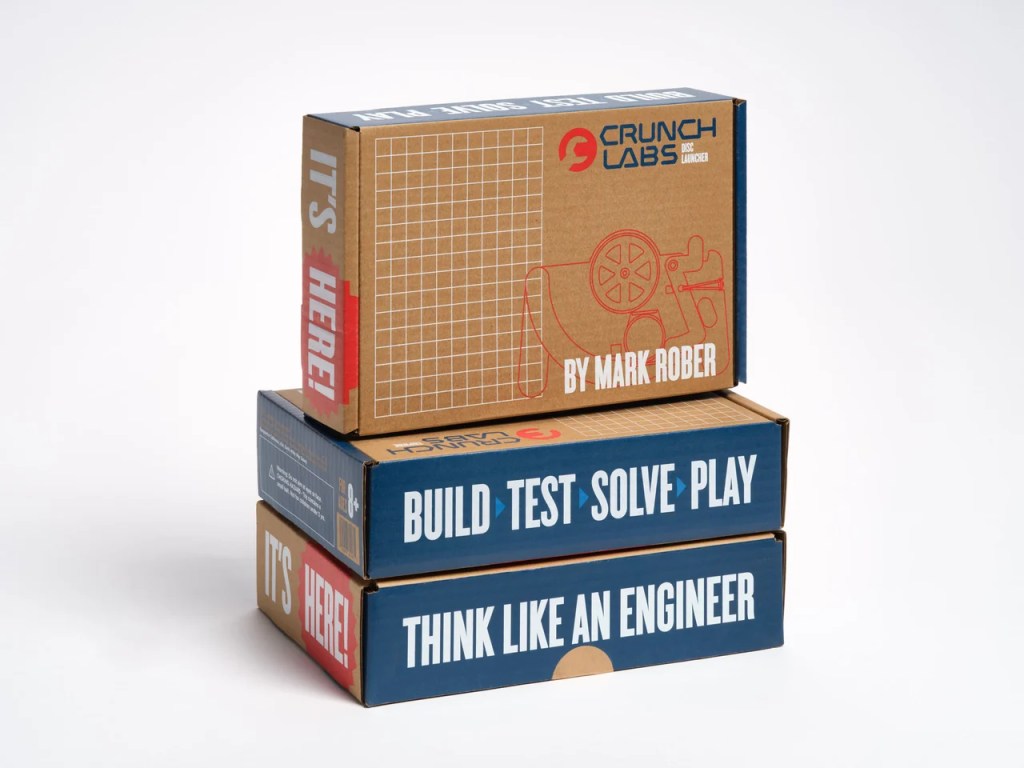
For her eighth birthday, our daughter received a subscription to CrunchLabs Build Box, created by former NASA engineer and YouTuber Mark Rober.
Three boxes in, I think it might be one of the best presents she’s had. Although I should probably point out that I have now been repeatedly fired at with flying discs in my own home.
More on that later.

Engineering, but make it fun
The premise behind CrunchLabs Build Box is pretty simple. A new box arrives each month containing everything children need to make a working engineering project. Build Box is aimed at ages 8–13, with each creation teaching a different engineering concept.
So far, we’ve had the Disc Launcher, Coin Spinner and Trip Wire. And they’ve all been a hit. You follow the instructions, put it together and, hopefully, end up with a creation that actually works.
And these aren’t things that get built, admired and put on a shelf.
Oh no. They get used. Particularly the Disc Launcher.
Mostly at us. Apparently, engineering becomes considerably more interesting when Mum and Dad are the targets.

Would she willingly learn about momentum transfer?
No. Would she build a Trip Wire and learn about it accidentally? Absolutely. And that’s probably what I like most about CrunchLabs.
Each build demonstrates a different engineering principle. The Disc Launcher explores flywheels, the Coin Spinner introduces ratchets and the Trip Wire teaches momentum transfer.
The learning almost sneaks in around the fun. She has to follow instructions, work things out, put pieces together and understand what’s happening. If something doesn’t quite work, she has to go back and figure out why.
That’s my sort of educational toy.
The only YouTube channel I actually encourage
There’s another part of CrunchLabs that I wasn’t quite expecting to enjoy as much as I do. The videos. Each Build Box comes with a video from Mark Rober explaining the engineering and science behind the project.
And when my daughter asks:
“Can I watch Mark Rober?”
I say yes. Enthusiastically.
This is not my usual response to YouTube. Usually there’s a certain amount of:
“What are you watching?”
“Who is that?”
“Why are they shouting?”
“How long have you been watching this?”
“Surely there can’t be ANOTHER episode?”
Mark Rober, however, has somehow achieved the impossible. He’s created YouTube that my eight-year-old actively wants to watch and I actively want her to watch. The videos are funny, energetic and entertaining (everyone’s a big kid at heart) enough to keep her interested, while actually explaining the science behind what she’s doing.
And (whisper it) I’m learning things too. I’ve found myself watching alongside her and thinking: Ohhhh. So that’s how that works. Who knew? Apparently my understanding of ratchets was not quite as comprehensive as I had previously imagined.
I may also have a small Mark Rober problem
I should probably declare at this point that I may have developed a slight soft spot for Mark Rober. Former NASA engineer. Makes children excited about science. Funny. Builds ridiculous things.
What’s not to like? This is, of course, entirely irrelevant to the educational merits of the CrunchLabs Build Box.
So we’ll move swiftly on.
The joy of waiting for the next one
One of the other things I really like about the subscription is that the birthday present hasn’t ended.
Usually, there’s the huge excitement of the birthday itself and then it’s over. With this, another box arrives. And then another.
There’s that moment when she realises it’s a CrunchLabs delivery and wants to know immediately what’s inside. In a world where we’re all becoming rather used to getting everything instantly, I quite like the anticipation.
What’s the next build?

What will it do?
And, perhaps most importantly from a parental perspective:
Can it be fired at me?
I now feel this is a question worth asking.
It’s not about creating an engineer
I’m under no illusion that because my daughter is building CrunchLabs projects at eight, she’ll necessarily become an engineer. She might. She might do something completely different. That’s not really the point.
What I love is seeing her interested in how things work.
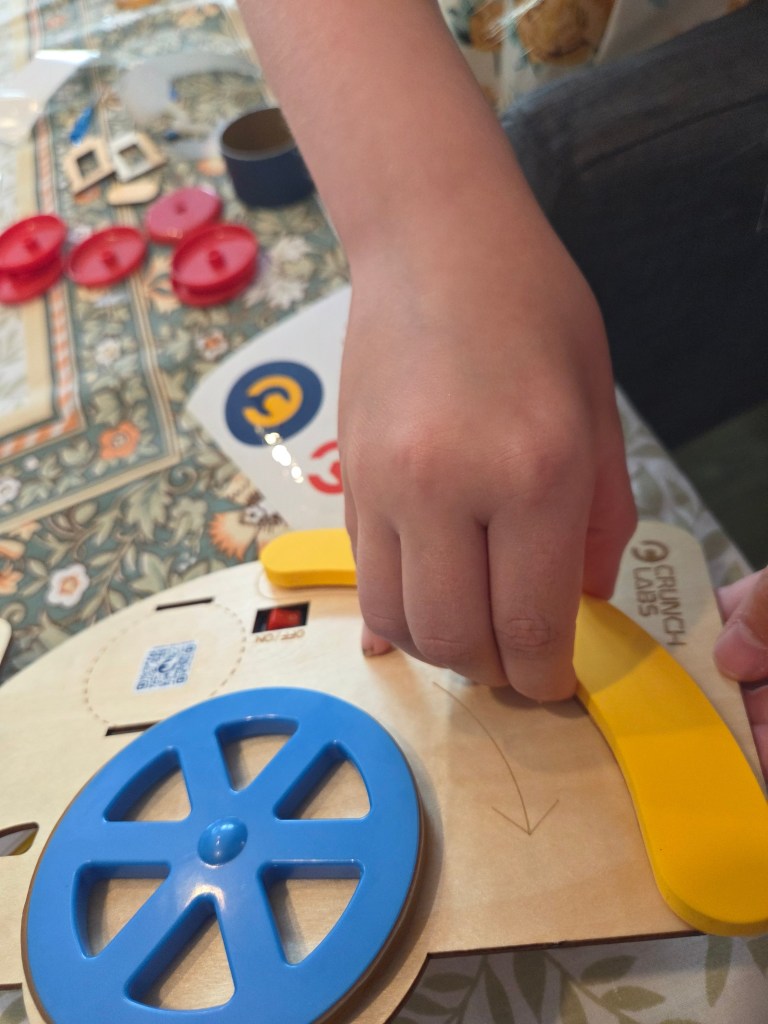
She’s making something with her own hands. Following instructions. Solving little problems. Getting something wrong and trying again. She’s learning that the finished thing doesn’t magically appear from a box.
She made it. And there’s a real sense of achievement in that.
Of course, the sense of achievement becomes particularly evident when the Disc Launcher works successfully and a small plastic disc sails across the room towards Dad.
But still. Engineering.
Three boxes in…
So far, the verdict in our house is a very definite thumbs up. My daughter has built a Disc Launcher, Coin Spinner and Trip Wire. She’s learnt about flywheels, ratchets and momentum transfer. I’ve learnt about flywheels, ratchets and momentum transfer.
We’ve discovered a YouTube channel we’re both happy to watch.
And I have learnt to approach certain areas of my own home with considerably more caution than I did before.
Now we’re waiting to see what arrives next. My daughter is very excited. I am too.
Although perhaps for slightly different reasons. I’m just hoping the next one isn’t designed to be fired at parents…
Find out more about the CrunchLabs Build Box.

